| |
April 5th, 2011, 11:54 am
The Sharks again embarrassed an opponent last night, just crushing the Kings 6-1. As you can see in our twitter feed to the right (woo hoo! new features!) the Sharks should have been a giant favorite, mostly because the Kings were missing their top two scorers. The Sharks had five players on the ice with more points than their top scorer last night, Dustin Brown.
And yet, there’s room for improvement. Check out this great post by Justin Bourne writing on the Puck Daddy blog. For whatever reason, he uses film clips almost exclusively from last night’s game to show what not to do, and our own Joe Thornton was the object of one lesson. I’m sure the coaches saw these, and I’d like to think corrections will be made. Even in my beer league leaving guys all alone in the slot is reason for derision.
We’ll be recording and posting the podcast tomorrow night after the Ducks game.
April 4th, 2011, 12:32 pm
 Welcome to the Land of the Big Boys As us Dudes thought, the Sharks top junior prospect, Taylor Doherty, has been reassigned to Worcester for the remainder of the AHL season for their playoff push. His OHL junior team, Kingston, lost their first round match up and he was already signed to an entry level deal. We’ve seen this move before by the Sharks with Logan Couture in the past and it’s a good opportunity to see him play with grown men. I would imagine he’ll play immediately and it’s not impossible that the kid will be brought up to San Jose for the Stanley Cup playoffs if Worcester is eliminated, not to play but to give him a taste of the NHL good life.
Doherty is the most intriguing Sharks prospect for me. He has incredible size and skill for a towering kid of 6’8. Can he develop into Tyler Myers, or will he be an American version of our favorite whipping-boy, Mr. Semenov? This will be a small glimpse into how he handles himself on the professional level.
April 1st, 2011, 10:10 am
The Dudes only have one game to talk about- the 6-0 pasting of the Stars – but they do it with relish. Now that the season is finally winding down, it’s time to talk about possible first round matchups in the east and west, who will likely be playing when everyone gets healthy again, and of course, listener emails.
Note: I’m experimenting with lower encodings, this week’s show was encoded at 64kB because of a request to make the file smaller. I want to see if this measurably affects audio quality.
Podcast: Play in new window | Download
March 31st, 2011, 10:13 am
It’s been a while since I wrote a stats-related post, and I figured I’d write one to piggyback on an interesting post on the Behind the Net blog (not to be confused with Behind the Net, the numbers site). A while back I did a purge on the RSS feeds I read, and for some stupid reason, this blog was amongst the casualties. I really must have been in a slash-and-burn mood that day, because it’s really one of the best hockey blogs out there if you are statistically inclined. What I want to do today is highlight some of the stats talked about in the linked post, and who on the Sharks are the best at those categories.
First of all, some real quick and dirty explanations of some of the stats referenced there. I would recommend reading more about them, but not everyone can spend hours reading about advanced hockey metrics. And as Doug would say, why would you want to?
- GVT – Goals Versus Threshold. A complicated stat that tries to create one number for the value of a player, measured in goals in a season versus the value of a replacement-level player. Similar to VORP in baseball.
- Rating – a BTN stat that is the difference between your team’s +/- per 60 minutes when you are on the ice versus when you are off the ice. Unlike the regular +/- stat, it helps level the playing field for those on bad teams.
- QualComp – quality of competition. The weighted average of the Rating of the players you face on the ice.
- Corsi – a +/- stat that counts shots instead of goals. Actually, it counts all pucks directed towards the net, including missed and blocked shots. Unfortunately, it’s similar to the +/- stat in that players on good teams generally have better ones. Of the 28 players that have played a game for the Sharks this season, only 10 have negative Corsi, and most (Moore, Mashinter, Desjardins, McLaren, Wingells) aren’t regulars.
- Corsi Rel – The difference in your Corsi when you’re on the ice versus off.
- Corsi Rel QoC – Quality of Competition calculated not by +/- per 60, but Corsi Rel.
- Zone Starts – the percentage of shift-starting faceoffs being in the offensive zone.
If you’re still reading, pat yourself on the back, because that’s a load of math. Let’s highlight the different Sharks players leading the categories in the stats that the LOES highlighted, in the order that I think is most important. The following is all 5v5 stats, and I’m not including anyone that’s played fewer than 10 games.
Corsi Rel – Kyle Wellwood – 14.6
It’s surprising, and doubtless related to a red-hot Joe Pavelski and clicking third line since he arrived. Still, Wellwood leads the team in a stat I believe is miles better than +/-. One downside to Corsi Rel is that time-on-ice isn’t factored in, and it should be noted Wellwood has averaged only 13.07 minutes of even-strength ice time per game, good enough for 15th on the Sharks. For this reason, it’s worth mentioning the second place player, Ryane Clowe (14.1), who’s averaging more than two minutes more 5v5 ice time, and who I might argue is the team’s MVP. Top Corsi Rel among defensemen? Jason Demers (8.6).
QualComp – Patrick Marleau – 0.101
Marleau is way out in front on this stat, with the second place Joe Thornton at 0.087. Despite the fact that Marleau tends to play the wing more now, traditionally not as defensively important as center, he’s the go-to guy when the other team’s top line is on the ice. Top defenseman – Dan Boyle (0.062).
Corsi Rel QoC – Patrick Marleau – 0.885
I’m not sure why the LOES like Corsi so much yet mention QualComp instead CorsiRel QoC. If Corsi is better than +/-, then Corsi Rel QoC is better than QualComp. Maybe that’s what they meant. Anyway, unsurprisingly, Mareau leads again, but there’s a bit of shifting under him. Jumbo drops to 5th on the team, and Joe Pavelski (0.747) moves up to 2nd. Boyle moves up to 3rd.
Zone Starts – Scott Nichol – 39.4
This means when Nichol took a faceoff to start a shift, 60% of the time it was in the defensive zone. That’s a lot of trust from the coaching staff, and certainly related to the fact that Nichol is the best faceoff guy on the team. Like the last stat, it’s a way of measuring how sheltered a guy is. It’s been calculated that you give up about 0.25 shots every time you take a faceoff in the defensive zone, so this is why Nichol’s Corsi isn’t so good. With that in mind, it’s unsurprising that Marc-Edouard Vlasic (46.8) has the lowest zone start percentage among defensemen.
Time on Ice – Dan Boyle – 19.13
No doubt Boyle is the workhorse, and even strength is no exception. He also plays the most PP and ES time. Contrast this to the Ducks (for instance), with Vish leading the category, but if you look for #2, you see that Toni Lydman and Cam Fowler play about the same amount. However, Fowler plays almost no PK, and three and a half minutes per game on the PP. Lydman is the opposite, almost no PP time, but is way out in front of PK time. Certainly important when trying to evaluate a player.
I didn’t include GVT here because there isn’t a day-by-day calculation of GVT that I know of, and to be honest, GVT makes a lot of assumptions about the weights of various measures that I don’t necessarily agree with. I won’t go so far as to say the attempt to create one stat that measures everything is a fool’s errand, but I feel like I get a better picture of a player when I look at several stats, and not just one.
Just a note for tonight- Jamie Benn and Alex Gologoski lead the Stars in Corsi Rel, so watch out for those guys.
Tags: Dallas Stars, Dan Boyle, Jason Demers, Joe Pavelski, Joe Thornton, Marc-Edouard Vlasic, Patrick Marleau, Ryane Clowe, San Jose Sharks, Scott Nichol, stats
Comments Off on Stats, Glorious Stats
March 25th, 2011, 12:11 pm
I know there’s no crying in baseball, but how about hockey? Mike and I have both been swamped with “real life” stuff. WAAAHH. How dare that interfere with our alter egos/hockey podcasting lifestyle!!!
 LA Kings overpriced forward Ryan Smyth crying because there was no podcast this week. Anywho, we apologize for the delay in the podcast and we will have a new episode live, in living color, on Sunday afternoon. We should be back on track to our regular scheduled programming with mid-week episodes starting next week.
Last night was a solid point on the road for the Sharks and I was pretty pleased with how they gutted it out. Those are games that in past this collection of core players have dropped, a tough road match up on the 2nd game of a back to back. Sharks need to keep winning, the Pacific Division is no lock by any means. It comes down to who will win a best of three series down the stretch between the Phoenix Coyotes and the Sharks. Three games, winner takes Pacific Division. I think it’s that simple. Two of these tilts are in Phoenix, so they have the advantage. Phoenix also has Colorado on their schedule and the Sharks have no cupcakes in their final seven (Phoenix x 3, Anaheim x 2, Dallas, LA). Saturday night is pretty important folks. Let’s go get two points.
WESTERN HOCKEY LEAGUE/YOUNG DUDES PREVIEW
The WHL playoffs start tonight with five young dudes involved in the postseason run for the Ed Cheynoweth Cup. Here we go.
EAST
#1 Saskatoon Blades vs. #8 Prince Albert Cougars – Sharks prospect riser, Marek Viedensky, is a top player for Saskatoon with 88 points and an amazing +60 rating.
#4 Kootenay vs. #5 Moose Jaw Warriors – Thomas Heemskerk is the goalie for the Warriors and has had a mediocre season statwise. Can he pick it up and take Moose Jaw on a run?
WEST
#1 Portland WinterHawks vs. #8 Everett Silvertips – The decision by 2009 Sharks 2nd round pick, William Wrenn, to jump from University of Denver to the WHL appears to be stroke of genius in terms of his career development. He went from a overlooked bottom pairing d-man not getting a regular shift to a guy playing solid minutes and posting 13 points and a +25 rating in 29 games for the top seed.
#2 Kelowna Rockets vs. #7 Prince George – Local Bay Area kid, and new San Jose Sharks free agent prospect, Sena Acolaste is one of the WHL’s top blueliners. He’ll shoot for the upset here against Kelowna.
#3 Spokane vs. Chilliwack Bruins – Sharks prospect camp signee, Curt Gogol, plays for Chilliwack and is 3rd in the WHL in penalty minutes with 201 PIMs. Not sure how much of an impact he’ll have on a playoff run, but we’ll keep an eye on him.
YOUNG DUDE OF THE DAY
Phil Varone gets the nod with a goal and an assist in Erie’s 2-1 win in the opening round of the OHL playoffs. Phil-er up. Here’s his playoff blog for everything Otter and Varone related to make your Friday even brighter.
March 22nd, 2011, 8:27 am
The wife was out and I had the TV all to myself.
The result was predictable – some NHL 11 on the PS3, Pittsburgh vs. Detroit on Versus, an episode of Boardwalk Empire on DVR and then right back to the PS3 to stream Calgary vs. LA Kings on NHL Gamecenter. There were some important points at stake tonight and, even with Detroit’s huge comeback, they left a valuable punto flapping in the breeze. I think it’s pretty vital the Sharks do everything they can do snag that #2 seed so, if we do get Detroit in the Conf. Semis again….and you know we will….the Sharks will have home ice. It worked last time, let’s not make New Coke here.
Calgary lost in the shootout in LA last night and lost in OT vs. Anaheim on Sunday, so with seven games left to go, the Flames are scrambling to keep up in the Western Conference playoff race. We’re going to see a desperate team on Wednesday night. Calgary has lost five out of six and despite an easy end to their season schedule wise (including the terrible trio of Edmonton twice, Colorado and St. Louis) they are likely going to be missing the party if they don’t win tomorrow. Look for Iginla and the Flames to throw everything they have left in the tank at the boys tomorrow – but I just don’t think it will be enough. Sharks should play the bully and throw out Calgary’s season like expired Lactaid. Peace out Kipper. I hope you pull yourself from the game on Wednesday like you did in the Olympics.
The first round of the Ontario Hockey League playoffs begins on Thursday, March 24th. Below are the match-ups of interest featuring the Sharks “Young Dudes”.
EAST
#1 Mississauga vs. #8 Belleville Bulls – Sharks goalie prospect, J.P. Anderson, is the starting goalie for Mississauga and also leads the OHL in several important goalie categories. You may remember him from his cameo in San Jose from his cameo as “Who The Hell is That Goalie #2” in January when he was called up on an emergency basis by the Sharks and fetched Neemo’s Del Taco. He signed a three year deal out of rookie camp.
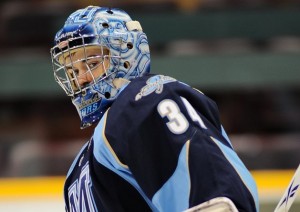 J.P. Anderson as Man in Mask #2 Ottawa 67s vs. #7 Sudbury Wolves – Sharks forward prospect, Michael Sgarbossa, is the Wolves leading scorer with 82 points and 77 PIMs. The undersized speedster was signed out of rookie camp in September by the Sharks to a three year deal.
#3 Niagara Ice Dogs vs. #6 Brampton Battalion – 2010 5th round draft pick Freddie Hamilton is 2nd on the Ice Dogs in scoring with 83 points. He appears to be a steal for a 5th round pick and has a good reputation, scoring touch and work ethic. The Dudes are going to keep an eye on this 19 year old.
#4 Oshawa Generals vs. #5 Kingston Frontenacs – One of the crown jewels of the Sharks system, defensemen Taylor Doherty (recently ranked #3 by Hockey’sFuture.com for Sharks prospects) is the team captain of Kingston and his 6’8 beastly frame will be a major factor in the playoffs. Doherty is signed to a three year EL deal and could appear in Worcester when his season ends in Kingston….actually, I would bet on it.
 The Young Great White - Taylor Doherty WEST:
#3 Kitchener Rangers vs. #6 Plymouth Whalers – Recently signed as an undrafted free agent for the 2011-12 season, James Livingston, plays forward for the Whalers and is 4th on the team in scoring with 50 points. He is a physical player with net presence and defensive instincts.
#4 Windsor Spitfire vs. #5 Erie Otters – Sharks 5th round pick in 2009, Phil Varone, is the Otters 2nd leading scorer with 82 points. He is mini-spark plug at 5’9 enjoying a healthy season after being injured for half of 2009-10 and is currently unsigned by San Jose.
We will keep you posted on any highlights including our Young Dudes and how their playoff journeys pan out.
YIUUUUUUUUU!!!! GO SHARKS!
March 20th, 2011, 9:58 am
Since there’s no real update on Logan Couture’s injury, except for his post on Twitter saying “Thankfully, it isn’t as bad as it looked or first felt. Hope to be back soon!”, I turned my Sunday morning hockey fix towards the NCAA tournament…and not the one most average Dudes care about.
This morning, the NCAA announced its field of 16 teams for the NCAA Division I Men’s Ice Hockey Championship Bracket. The opening round games can be watched on ESPN3 and/or ESPNU.
We profiled the Sharks prospects and their junior and NCAA playoff prospects in our latest episode and I guessed that Charlie Coyle and Boston University might snag an at large bid, but they were left out in the cold and one of those coveted spots went to another Sharks prospect, defensemen Lee Moffie, and the University of Michigan. Moffie is tied for the team lead among d-men with seven goals in only 28 games and he’s a +10. He figures to play a key role in Michigan’s NCAA hopes as a sophomore, so we’ll be keeping an eye on the 2010 7th round pick next weekend.
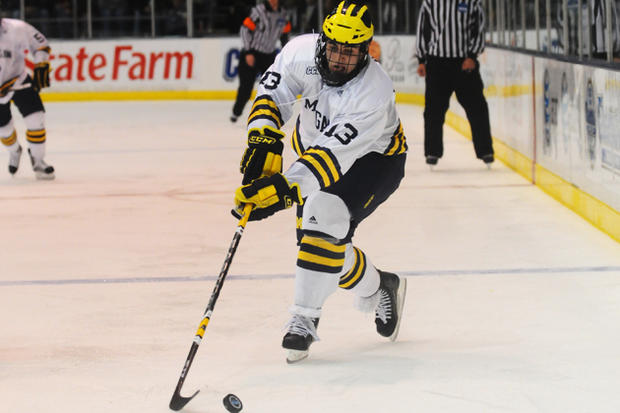 Lee Moffie/Michigan Wolverines Isaac MacLeod (5th round in 2010) is a freshmen member of the overall #3 seed, Boston College Eagles. The 6’5 blueliner has appeared in 24 games this year, but has been a scratch in four of the last five games, so I don’t think we should expect to see him on the ice in the NCAA tournament unless someone goes down with an injury.
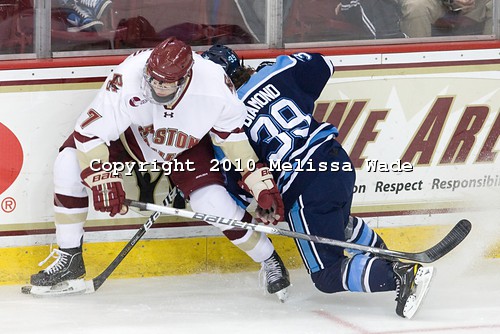 Isaac MacLeod with the Check Monster Enjoy the hockey version of March Madness. We will keep you updated on the fate of our Young Dudes in the NCAA, OHL, WHL and QMJHL playoffs.
Comments Off on NCAA Hockey Tournament Bracket announced. Moffie and MacLeod get to dance.
March 15th, 2011, 9:06 am
The Sharks have technically lost four out of five with a crucial battle against division rival Dallas on tap tonight. The Dudes will return to the pre-recorded podcast airwaves on Saturday with a special double episode as we head for the playoff push to talk all things Sharks, playoff positioning, possible opponents and a preview of Sharks prospects and their OHL, WHL, QMJHL and NCAA hockey playoff battles.
Look for us then. Go Sharks!
March 4th, 2011, 9:23 am
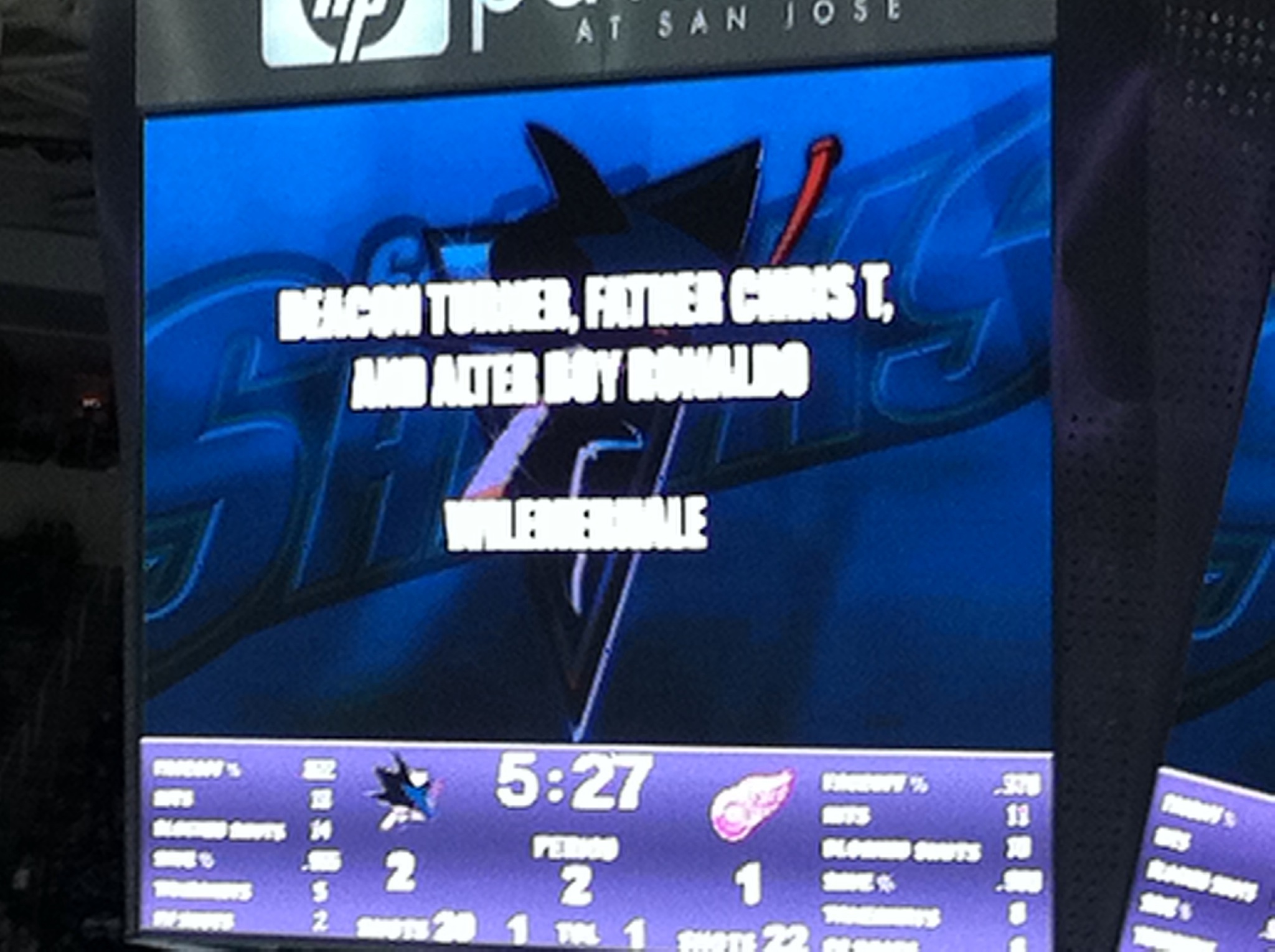
Between periods, the Sharks put up various groups that are attending the game that night, and we managed to grab a shot of this one.
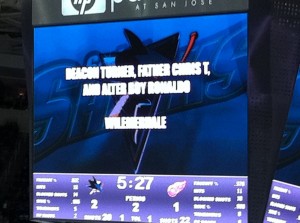 Wasn't aware "alter boy" was a title
Uh, discuss.
February 26th, 2011, 7:39 pm
I like reading sports books, and I like reading economics-type books. Which is why I was interested to read Sportscasting: The Hidden Influences Behind How Sports Are Played and Games Are Won. Worst case, they’d have some interesting theories about sports with scarce or anecdotal data to back it up (the way some people criticize Malcom Gladwell’s work) and best case it would really shed light on some interesting sports conundrums. So which is it?
Actually, the latter. And in order to achieve it, the authors crunched a ton (is it tonne in Canada?) of data. It’s not nearly as breezy as a Gladwell read, but it’s meatier. More tables, more numbers, more statistics, more explanations and hedges about what can properly be controlled for, and what can’t. Those who have read this site for a while and listened to our podcasts know I love that kind of thing. A couple of long chapters of the book are setting up the dominos to answer the question- why do home teams have such a big advantage?
There’s no doubt there IS an advantage, and it’s substantial in pretty much every sport. Soccer is the most lopsided, with well over 60% of games being won by the home team (they calculated the numbers for MLS, EPL, Serie A, La Liga, and others). Basketball is next, with the NBA home teams winning 62.7% (they even calculate WNBA and college). The NHL is next, with 59% percent of home teams winning, and football (57.8%) and baseball (54.1%) bringing up the rear.
So, some things that are interesting about this discussion, the first being obvious, the others not (but backed up by the data).
- Home teams win the majority of games, sometimes a significant majority.
- This winning percentage is constant across time. The winning percentage of home teams was about the same 50 years ago as it was 10 years ago, or now.
- The winning percentage is directly related to the sport itself. Japanese baseball home teams have about the same winning percentage as MLB home teams. Arena football the same as the NFL.
I’ve never thought about this too much before, but even #1 is really remarkable. Why do home teams win so much, and so consistently? There has been no NHL season where away teams won more games than home teams. As watchers of plenty of NHL games, I’m sure we all think of several reasons why this is. One is the home crowds- the home players play better when you’re cheering them rather than booing them. Another is travel- away teams have to deal with hotels, unfamiliar surroundings, and jetlag.
Incredibly, the authors make very good cases that both of these are myths. It’s really hard to control for home crowds, because there are so many other interactions going on. But here’s one feat in hockey that’s essentially isolated from all those player and referee interactions- the shootout. It’s basically an interaction between two players and the crowd. So if the crowd were a factor in home player’s effort and performance, you expect the shootout to have a home-rink advantage the way the rest of the game does, right? Well, it doesn’t. Since the shootout started, away teams won the shootout 50.6% of the time. The home-rink advantage just doesn’t exist in the shootout.
And, amazing, they manage to control for travel as well. How could you do that? Well, what about teams that are really close together, like the Devils, Rangers, and Islanders? You’d expect less home advantage when those teams play each other, because they don’t have to really go anywhere- just drive a bit further. But if you look at those games, the home advantage is exactly the same as all the other games. They found there is a small effect with back-to-back games, which in most sports occur more often on the road. But that’s not nearly enough to explain it all.
So what the hell is it? I’m going to put a break here in the post, because some people might actually want to read the book and not get the spoiler. I’ve condensed many pages into this post, and believe me, it’s worthwhile to read all the other support the authors have come up with. Or, more likely, you just want to bail out because there’s too many words reading sux zzzzz…..
(more…)
|



 More Destruction, But Room For Improvement


 Loading ...